
Introduction
If you’re researching investment strategies for high income earners, you’ve probably noticed something: most advice sounds identical. Max out your 401(k). Diversify. Think long term.
That guidance isn’t wrong. It’s incomplete.
High income changes the rules.
Once your marginal tax rate moves into the top brackets, investing stops being just about picking funds. It becomes a structural exercise — where assets are held, how income is recognized, and how much silent tax friction is compounding in the background.
At higher income levels, contribution phaseouts, the 3.8% Net Investment Income Tax (see IRS overview), equity compensation complexity, and estate thresholds begin to interact in ways that basic investing articles rarely address. Small structural inefficiencies — a poorly placed bond fund, an unmanaged RSU position — can compound meaningfully over decades.
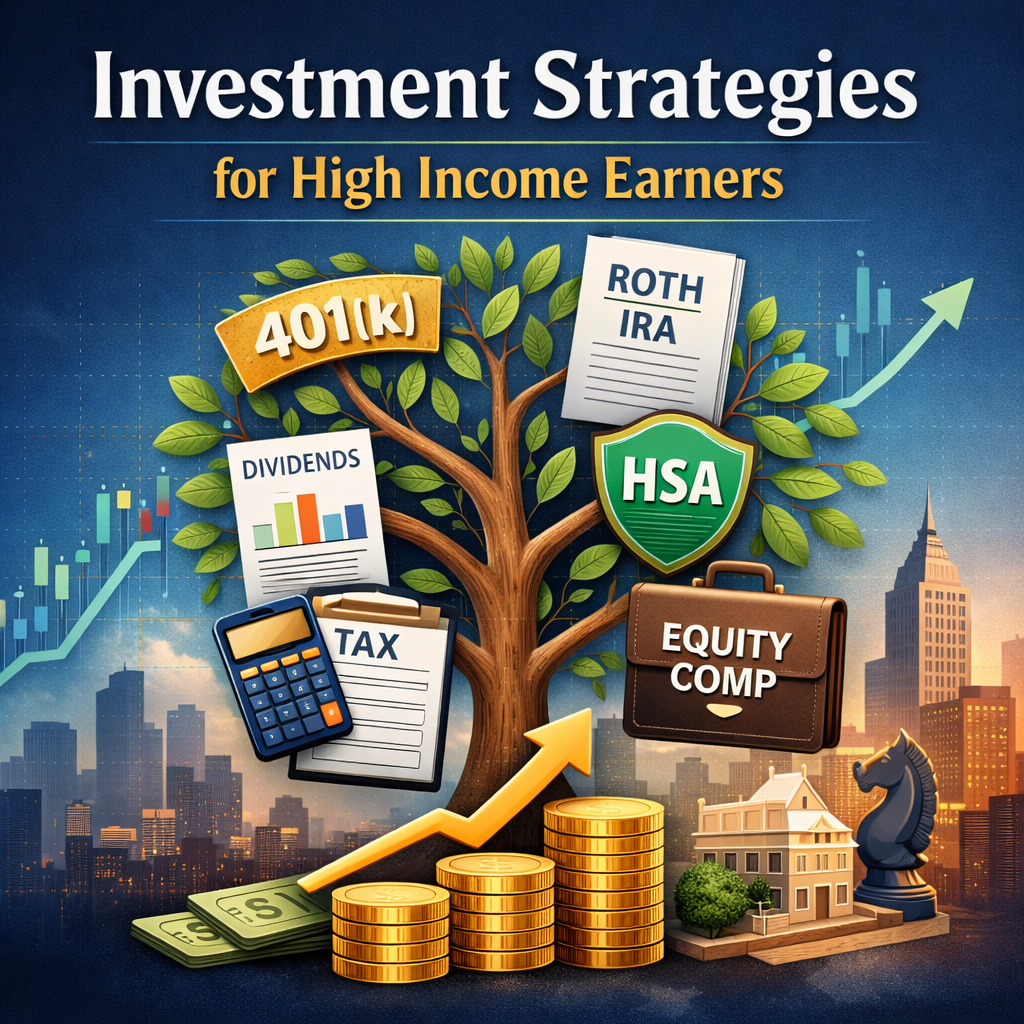
This guide goes deeper and provides a brief overview of other options available. You’ll see how retirement stacking, asset location, concentrated stock management, and tax-efficient investing connect. Portfolio construction and estate flexibility are part of the same system — not isolated decisions.
The goal isn’t complexity for its own sake.
It’s clarity.
The 5 Core Strategies High Earners Use First
Most high-income earners prioritize investing in this sequence:
- Maximize employer retirement plans
- Execute a Backdoor Roth IRA
- Fully fund a Health Savings Account (HSA)
- Optimize taxable accounts using asset location
- Actively manage concentrated equity exposure
That order reflects marginal tax exposure first, liquidity flexibility second, and risk management third.
Maximize Tax-Advantaged Retirement Contributions
For 2025 and 2026, IRS rules allow substantial salary deferrals into employer-sponsored plans, with additional catch-up provisions for those over 50 (see IRS contribution limits).
High earners should also evaluate whether after-tax 401(k) contributions and in-plan Roth conversions are available — often referred to as a Mega Backdoor Roth.
Deferring income at a 32%–37% marginal tax rate (see IRS tax brackets) changes long-term compounding math. A dollar deferred today may grow for decades before being taxed.
But pre-tax isn’t automatically superior to Roth. The right choice depends on projected future income, state residency, and estate goals. Tax deferral is powerful — yet flexibility can be equally valuable.
Use Backdoor Roth and HSA Strategies Intentionally
Direct Roth IRA contributions phase out at higher income levels (see Roth income limits).
A Backdoor Roth strategy typically involves:
- Making a nondeductible IRA contribution
- Converting it to Roth
- Managing the pro-rata rule carefully
That last step is where many mistakes occur.
An HSA deserves special attention.
It offers three layers of tax advantage:
- Tax-deductible contributions
- Tax-deferred growth
- Tax-free withdrawals for qualified medical expenses
This structure is outlined by the IRS HSA guidelines.
When invested long term — rather than used as a short-term spending account — an HSA can become one of the most tax-efficient vehicles available.
Optimize Taxable Brokerage Accounts
Eventually, taxable investing becomes necessary.
This is where asset allocation and asset location diverge.
Asset allocation answers: What do you own?
Asset location answers: Where do you hold it?
High earners in elevated tax brackets may benefit from placing tax-inefficient assets — such as high-yield bonds — inside tax-deferred accounts. Broad equity ETFs with lower turnover are often more tax-efficient in taxable accounts.
Research from Vanguard on asset location suggests proper placement can improve after-tax outcomes over time.
Municipal bonds may provide federally tax-exempt income (see municipal bond taxation) — but suitability depends on yield spreads and state residency.
Context matters.
Why High Income Changes the Investment Equation
At a basic level, investing balances risk and return, but at higher income levels, taxation becomes the third variable.
Marginal Tax Rates and Investment Income
The U.S. system is progressive. As income rises, each additional dollar is taxed at higher marginal rates.
High earners may also face the 3.8% Net Investment Income Tax (see IRS NIIT overview above).
Long-term capital gains are generally taxed at 15%–20% for high-income taxpayers (see capital gains rates), plus NIIT where applicable.
Short-term gains are taxed as ordinary income.
These distinctions compound over decades.
A one-percent difference in after-tax return can materially affect terminal wealth. Not immediately — gradually.
Contribution Phaseouts and Structural Constraints
High earners encounter:
- Roth IRA phaseouts
- Deductible IRA limitations
- Income-based benefit reductions
These structural boundaries require coordination across accounts.
The common advice — “just max retirement accounts” — ignores pro-rata rules and state tax interplay.
Complex? Yes.
Unmanageable? Not with planning.
Reducing Tax Drag Through Asset Location and Realization Strategy
Most investors focus on allocation percentages, but high earners benefit more from structural efficiency.
What Tax Drag Means
Tax drag refers to the reduction in portfolio returns caused by taxes on interest, dividends, and realized gains.
Bond interest is generally taxed as ordinary income, while tax-deferred accounts allow assets to grow without annual taxation, potentially improving compounding.
Asset location attempts to align:
- Tax-inefficient assets → tax-deferred accounts
- Tax-efficient ETFs → taxable accounts
- Municipal bonds → high-bracket taxable accounts
Strategic Capital Gains Management
High earners often accumulate large unrealized gains.
Tax-loss harvesting allows investors to offset gains with realized losses (see IRS loss deduction rules), but harvesting defers taxes — it does not eliminate them.
Its value depends on:
- Reinvestment discipline
- Future tax rate stability
- Portfolio turnover management
Used correctly, it reduces friction. Used poorly, it creates complexity without benefit.
Managing Concentrated Equity and Executive Compensation
For many professionals, the largest portfolio risk isn’t volatility.
It’s concentration.
Equity Compensation Layers
RSUs are generally taxed as ordinary income at vesting.
ISOs may trigger Alternative Minimum Tax exposure (see AMT overview).
NSOs generate income upon exercise.
Understanding tax timing prevents unintended bracket compression.
Concentration Risk Thresholds
If 40–60% of net worth sits in one stock, risk may exceed conventional diversification guidance (see SEC diversification guidance).
Liquidating everything in one year may trigger higher capital gains taxes.
Structured diversification strategies — sometimes using 10b5-1 plans — can reduce emotional and tax-driven mistakes.
There is no universal rule.
There is a process.
Portfolio Construction Beyond Basic Diversification
Diversification is often reduced to a slogan.
In practice, it requires measurement.
Risk-Adjusted Returns and Sequence Risk
Modern Portfolio Theory evaluates return relative to volatility, often using the Sharpe ratio (see foundational overview from Stanford Business).
But high earners approaching early independence must consider sequence-of-returns risk — the damage caused by negative early withdrawals.
Vanguard research on retirement risk highlights this timing effect:
Timing matters more than averages.
The Three-Layer Portfolio Model
Layer 1: Stability Layer
Cash equivalents and short-duration bonds covering 12–24 months of expenses.
Layer 2: Growth Layer
Broad-market ETFs with disciplined rebalancing.
Layer 3: Opportunistic Layer
Concentrated equity, higher-volatility assets, alternatives.
Segmentation prevents forced selling during downturns.
And psychologically, it supports discipline.
The Optionality Principle
Investing at high income levels is less about prediction — more about flexibility.
Pre-tax accounts reduce taxes today.
Roth accounts create tax-free income later.
Taxable accounts provide liquidity.
Maintaining all three builds optionality.
Tax law changes. Income changes. Life changes.
Optionality allows adjustment without penalty.
Conclusion: From Investing to Wealth Architecture
High income amplifies both opportunity and complexity.
Effective investment strategies for high income earners are not about chasing outperformance. They focus on reducing tax drag, managing concentration risk, and building structural flexibility across decades.
Retirement stacking.
Asset location.
Diversification measured correctly.
Tax diversification.
Liquidity layering.
Together, these create resilience.
Practical next steps:
- Map assets by account type
- Measure employer stock exposure
- Identify highest marginal tax friction
- Clarify wealth phase stage
Tax law varies by state and income profile. While general principles apply, consultation with a qualified tax or financial professional is recommended before implementing advanced strategies.
Markets fluctuate. Policy evolves.
Structure endures.
And over time, structure — not prediction — compounds most reliably.
Learn more about our alternative investment strategy for high earners or how to protect stock gains
