
How to Use Leveraged ETFs for Long Term Investing: Exploring the Possibilities
Imagine aiming for turbocharged returns in your investment portfolio. The allure of doubling or even tripling market gains is certainly tempting. This is where leveraged ETFs for long-term investing come into the picture, promising amplified returns compared to traditional investments. But like any powerful tool, they come with a significant catch.
I started my investing career in the real estate world where using leverage is the norm, rather than the exception. When I entered the stock trading world, I knew I wanted to use leverage in a similar way. So I explored many possibilities and ways to use leveraged ETF’s for long-term investing.
This comprehensive guide dives deep into the world of leveraged ETFs, specifically addressing the question: Can these instruments really be used for long-term investing, or are they better suited for short-term, speculative trading?
I’ll break down the complexities in a way that’s easy to grasp, exploring how leveraged ETFs work, the inherent risks they carry, and whether there are any viable strategies for using them in a long-term investment plan (spoiler: there are! Scroll down if you want to just learn about the strategies).
Decoding Leveraged ETFs: How They Actually Function
To understand how leveraged ETFs might fit into a long-term investing strategy (or why they might not), it’s crucial to grasp their mechanics.
Leverage, in general, is like using borrowed money to increase your potential returns. Back to my previous real estate career: a simple example is taking out a mortgage to buy a house. You control a much larger asset (the house) with a smaller amount of your own capital.
Leveraged ETFs operate on a similar principle, but instead of borrowing money directly, they use financial derivatives like swaps, futures contracts, and options. These instruments allow the ETF to gain exposure to a multiple of the underlying index’s performance.
For example, a 2x leveraged ETF tracking the S&P 500 aims to deliver twice the daily return of the S&P 500. A 3x leveraged ETF aims for triple the daily return.
The key concept to understand with leveraged ETFs is the daily reset. Unlike traditional ETFs that track an index over the long term, leveraged ETFs are designed to achieve their multiple (2x, 3x) on a daily basis.
This means that at the end of each trading day, the ETF’s holdings are rebalanced to reset the leverage back to the target multiple. While this sounds straightforward, it has profound implications for long-term returns, primarily due to the phenomenon known as volatility drag or beta decay, which we’ll discuss in detail later.
Let’s illustrate with a simple example:
Imagine the S&P 500 starts at 100. You invest in a 2x leveraged ETF tracking the S&P 500.
- Day 1: S&P 500 rises 1% to 101. Your 2x ETF rises 2% to 102.
- Day 2: S&P 500 falls 1% back to 99.99. Your 2x ETF falls 2% to 99.96 (102 * (1-0.02)).
Notice that even though the S&P 500 pretty much returned to its starting point, your leveraged ETF is slightly down. This is a simplified illustration of how daily resets can erode returns in volatile markets.
The Catch: Understanding Volatility Drag and Its Impact on Leveraged ETFs
Now we arrive at the core reason why using leveraged ETFs for long-term investing is generally discouraged by financial professionals: volatility drag, also known as beta decay. This phenomenon is a direct consequence of the daily reset mechanism we discussed earlier.
In simple terms, volatility drag is the erosion of returns over time due to the compounding effect of daily percentage changes, especially in volatile markets. Imagine a ball bouncing down a staircase. With each bounce, it loses some energy and doesn’t quite reach the same height as the previous bounce. This loss of energy is analogous to volatility drag.
Let’s go back to our previous example, starting at $100.
- Day 1: S&P 500 rises 1% to $101. Your 2x ETF rises 2% to $102.
- Day 2: S&P 500 falls 1% back to $99.99. Your 2x ETF falls 2% to $99.96 (102 * (1-0.02)).
Even though the index essentially returned to its starting point, the leveraged ETF has lost 0.04% of its value. This is because the 1% loss is calculated on a higher base (102) than the initial 1% gain.
This effect is amplified in choppy markets, where prices swing up and down frequently. The more volatile the market, the more pronounced the volatility drag will be. This is why leveraged ETFs are often unsuitable for long-term “buy and hold” strategies. The daily resets essentially reset the compounding, preventing the leveraged ETF from truly capturing the long-term investing of the underlying index.
Is volatility drag always bad? Not necessarily. In a consistently trending market, especially a strong bull market, the positive compounding from the leverage can potentially outweigh the negative effects of volatility drag.
Take the period from May 1st to July 15th, 2024 for example: throughout this period the S&P500 pretty much trended upward with a few losing days and returned 12%. The triple leveraged ETF UPRO returned 39% during that same time frame, which is more than the triple return one could expect.
However, predicting such sustained trends is extremely difficult, making this a crucial part of a long term strategy as I will discuss below.
The Downside: Weighing the Risks of Leveraged ETFs for Long Term Investing
Beyond volatility drag, leveraged ETFs carry several other significant risks that potential investors, especially those considering a long-term strategy, must understand.
- Magnified Losses: This is perhaps the most obvious risk. Just as gains are amplified, so are losses. A 10% drop in the underlying index will result in a 20% or 30% loss in a 2x or 3x leveraged ETF, respectively. This magnification can lead to rapid and substantial losses, especially during market downturns.
- The Risk of Ruin: Because of the magnified losses, the risk of losing a significant portion, or even all, of your investment is substantially higher with leveraged ETFs compared to traditional investments. A series of consecutive losing days can quickly erode the value of a leveraged ETF, making it difficult to recover.
- Performance During Market Crashes: Leveraged ETFs are particularly vulnerable during market crashes. The combination of rapid price declines and the leverage factor can create a perfect storm for significant losses. During the 2008 financial crisis, many leveraged ETFs experienced catastrophic declines, highlighting the extreme risk they pose during periods of market stress.
- Expense Ratios and Other Costs: Leveraged ETFs typically have higher expense ratios than non-leveraged ETFs. This is because the use of derivatives and the daily rebalancing process incurs higher management and trading costs. These higher costs further erode returns, especially over the long term.
- Liquidity: While most leveraged ETFs are relatively liquid, there can be periods of reduced liquidity, especially during times of market volatility. This can make it more difficult to buy or sell shares at desired prices
It is crucial to understand that the risks associated with leveraged ETFs are not merely theoretical. Numerous examples exist of investors suffering significant losses due to these instruments. Again, it is therefore crucial to have a solid back-tested and proven strategy that can be used for long-term growth with leveraged ETFs.

The Big Question: Long-Term Investing with Leveraged ETFs – Is It Realistic?
The central question of this entire guide is: Can leveraged ETFs be effectively used for long-term investing? The short answer, based on the information we’ve covered so far, is generally no. The combination of volatility drag, magnified losses, and the risk of ruin makes them generally unsuitable for traditional long-term “buy and hold” strategies. The consensus among most financial professionals reinforces this view. They typically advise against using leveraged ETFs for anything beyond short-term tactical trades or very specific hedging strategies.
The long answer is yes. There are scenarios and strategies where leveraged ETFs can be used for long-term investing with exponentially large effects. However, it is very important to take into consideration the risks described in this guide and develop a strategy around that.
The main issues discussed in this guide that need to be accounted for are the volatility drag and magnified losses.
As mentioned before, the more volatile the market, the more pronounced the volatility drag will be. This is why leveraged ETFs are often unsuitable for long-term “buy and hold” strategies. The daily resets essentially reset the compounding, preventing the leveraged ETF from truly capturing the long-term growth of the underlying index.
In addition, the magnified losses happen when the market crashes or during corrections or bear markets.
How Can We Safely Use Leveraged ETFs for Long Term Investing
It is crucial that a long-term leveraged ETF strategy tries to sidestep periods of sustained volatility and/or down markets, while amplifying returns during long-term upward trends.
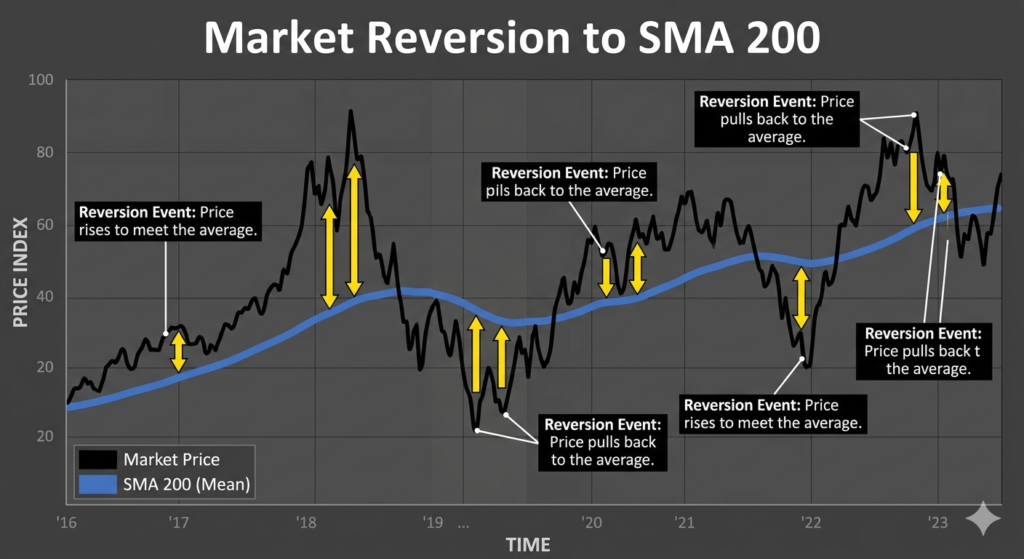
To do this, we can use trend trading indicators. A typical long-term trend line used in the stock world is the 200 day moving average (the average market value of the last 200 trading days, also called SMA200).
If you look at the graph below you see how markets revert back to this sma200 line over time. Once the market drops below this line volatility typically increases and a potential larger drop can occur.
An example of an ETF that used the sma200 is PLTC. PLTC is a S&P500 based ETF with $3 billion under management and the strategy is very straightforward. It comes down to this:
If the SPY is below the sma200 for 5 consecutive days, sell your SPY position, if it’s above the sma200 for 5 consecutive days, buy SPY.
This simple strategy sidesteps most of the volatile periods and major downturns in the market. Since the market is above the sma200 most of the time, holding periods are often multiple months or even years, which I consider long-term.
How Does This Work For Leveraged ETFs?
This strategy can easily be used for leveraged ETFs as well. I tested the strategy over the last 20+ years using triple leverage and the results were 18% per year. Not bad at all!
One downside of the strategy, though, is that there is quite a few back and forth trading during periods when the market hovers around the sma200. This back and forth causes many losing trades, often back to back.
Additionally, it often causes a potentially long-term trade to be exited too soon, resulting in a short-term trade and therefore short term capital gains taxes if you trade in a brokerage account.
To solve this problem, other trend lines can be introduced or even a combination of trend lines and other technicals. I have back-tested many different variations and parameters and optimized long-term trend trading strategies for leveraged ETFs. I have tested this with 50 years of historical data which resulted in an average annual return of ~25%.
I have been trading this strategy live for over 6 years, with annual returns of 33%. So, yes! Leveraged ETFs can most definitely be used for long-term investing and I would highly recommend you at least look into it and consider it for your portfolio since it could be a great tool to amplify your returns.
Just keep in mind that it’s absolutely crucial to emphasize the role of active management monitoring if you are considering using leveraged ETFs. These are not “set it and forget it” investments. Because of the daily resets and the potential for rapid losses, it’s essential to keep a close eye on your positions and be prepared to exit the market when volatility is too high or markets start dropping a lot.
Final Thoughts: A Balanced Perspective on Using Leveraged ETFs for Long-Term Investment
This comprehensive guide has explored the complex world of leveraged ETFs and their suitability for long-term investing strategies. We’ve delved into the mechanics of these instruments, explaining how they use leverage and the crucial concept of daily resets. We’ve also highlighted the significant risks they carry, particularly volatility drag, magnified losses, and the potential for rapid declines during market downturns.
The key takeaway is that leveraged ETFs are generally not appropriate for long-term “buy and hold” investing. The negative effects of volatility drag and the heightened risk of substantial losses make them unsuitable for most long-term investors seeking steady growth.
However, with the correct strategy to avoid periods of volatility and to identify and follow trending periods, leveraged ETFs can most definitely be used for long-term investing and I would highly recommend you at least look into it and consider it for your portfolio since it could be a great tool to amplify your returns. I have back-tested several strategies with 50 years of historical data which resulted in average annual returns of ~25% and I’ve been trading this strategy live for over 6 years, with annual returns of 33%.
It’s crucial to understand that leveraged ETFs are complex financial instruments that require a deep understanding of market mechanics and risk management. They are not designed for novice investors or buy and hold investors. To get the results I got, without making the same mistakes or taking the same risks, you can learn more at www.thesscapitalgroup.com.
Before making any investment decisions, especially involving complex instruments like leveraged ETFs, it is strongly recommended to consult with a qualified financial advisor. They can help you assess your risk tolerance, investment goals, and overall financial situation to determine the most appropriate investment strategy for your individual need. Past results are not a guarantee for the future. All investment involves risk including the risk of losing the full investment. This is not investment advice.
