
Introduction
The debate over active vs passive management usually starts with performance charts. That’s understandable—but it’s also where many investors get quietly misled. The more meaningful differences between these approaches show up long before returns are tallied: in costs that compound slowly, in how portfolios behave during stress, and in whether investors can actually stick with a strategy when conditions change.
If you’ve felt frustrated by the conflicting opinions in this space—one side insisting passive investing always wins, the other arguing skilled managers can add value—you’re not alone. Most explanations stop at surface-level definitions or overly confident conclusions. What’s usually missing is context. When has each approach historically worked? Why do results vary so much by market and category? And how do these strategies fit into real portfolios rather than theoretical ones?
This guide goes deeper than the typical comparison. We’ll look at how active and passive investment strategies differ in structure, cost, risk, and behavior—drawing on long-term performance evidence, market regime insights, and practical portfolio considerations. Long-running industry research shows that a majority of active managers underperform their benchmarks over extended periods once fees are considered, yet the same data also highlights environments where outcomes look very different (industry research).
By the end, you’ll have a clearer framework for evaluating active management, passive management, and blended approaches—grounded in evidence, realistic about tradeoffs, and focused on decisions investors can actually live with over time. We’ll start with the fundamentals, then build toward the nuances that matter most.
Active vs Passive Management — A Clear, Evidence-Based Overview
At a basic level, active management and passive management differ in how investment decisions are made—and how closely a portfolio follows the market.
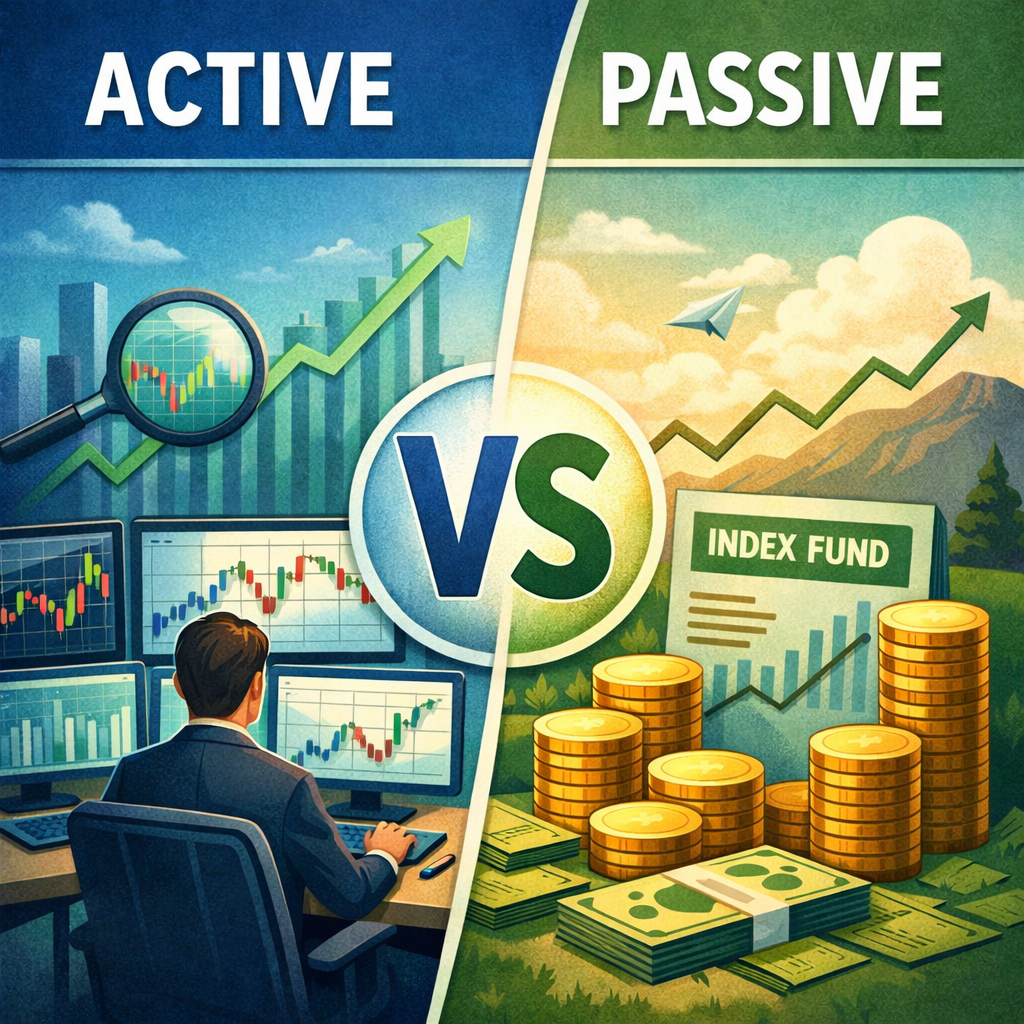
Active management relies on professional portfolio managers who select securities, adjust exposures, and attempt to outperform a benchmark through research, judgment, or risk management. Passive management, by contrast, seeks to replicate the performance of a specific index—such as the S&P 500—by holding the same securities in the same proportions, with minimal ongoing decision-making.
That distinction is straightforward. The implications are not.
Active management is not inherently speculative, and passive management is not entirely hands-off. Both involve tradeoffs in cost, risk, and behavior that only become clear over time. Over full market cycles, differences in fees, turnover, and exposure often matter more than short-term performance differences—one reason institutional research typically evaluates results over long horizons rather than single years (long-term studies).
Why this matters is simple: investors don’t experience markets in snapshots. They live through drawdowns, recoveries, and long stretches of uncertainty—exactly where these approaches tend to diverge.
How Active and Passive Management Actually Work
To understand the real differences between active and passive strategies, it helps to look under the hood.
In passive investing, portfolio construction is rules-based. An index fund tracks a predefined benchmark and adjusts only when the index itself changes—due to rebalancing, additions, or deletions. This keeps turnover low, reduces transaction costs, and minimizes deviations from the benchmark, often referred to as tracking error.
Active managers work differently. They make discretionary decisions about what to own, what to avoid, and when to adjust risk. They may overweight certain sectors, underweight others, or hold cash during periods of perceived uncertainty. Their performance is measured against a benchmark, but they are not required to mirror it. That flexibility introduces the possibility of alpha, but it also introduces manager risk—outcomes depend heavily on judgment and execution.
A common misconception is that active management always involves frequent trading. In reality, many active strategies operate with multi-year holding periods, particularly in less efficient markets or fundamental approaches (strategy classifications).
Why this matters: the mechanics determine costs, risks, and consistency. Understanding how each approach works helps set expectations before performance is ever evaluated.
Costs, Fees, and the Long-Term Impact on Returns
Costs are one of the clearest—and most underestimated—differences between active and passive management.
Passive funds typically have lower expense ratios because they require less research, fewer trades, and minimal oversight. Active funds generally charge higher fees to support research teams, portfolio management, and trading activity. The difference may look small in any given year, but over decades it compounds.
Even modest fee gaps can materially reduce ending portfolio values over 20- or 30-year periods, particularly when combined with higher turnover and tax drag (cost impact research). In lower-return environments, those effects become even more pronounced.
Costs also extend beyond published expense ratios. Transaction costs, bid–ask spreads, and taxable distributions all affect net returns. None of this makes active strategies inherently inferior—but it does raise the performance hurdle they must clear to justify their role.
Lower cost doesn’t guarantee better outcomes. Higher cost doesn’t guarantee value. But ignoring costs altogether is one of the most common—and avoidable—mistakes investors make.
Performance Evidence — What the Data Shows (and What It Doesn’t)
Most discussions of active versus passive management hinge on a familiar conclusion: over long periods, many active managers underperform their benchmarks after fees. That finding is well supported by extensive industry data (performance studies).
Still, it’s not the whole story.
Performance varies meaningfully by asset class, time period, and market structure. In highly efficient markets—such as U.S. large-cap equities—persistent outperformance is difficult. In less efficient segments, including parts of fixed income or smaller equity markets, outcomes have historically shown wider dispersion between managers.
Another nuance often overlooked is survivorship bias. Many datasets exclude funds that were closed or merged after poor performance, which can distort headline statistics if not properly adjusted (Morningstar analysis).
Data should shape expectations, not dictate decisions. Understanding why results look the way they do is far more useful than focusing on averages alone—especially for investors planning over decades.
Market Conditions and Regimes — When Differences Become Meaningful
Active and passive strategies often look similar during long, steadily rising markets. Differences tend to emerge when conditions change.
One key factor is return dispersion—the spread between winners and losers within a market. When dispersion is low, passive strategies often capture most available returns efficiently. When dispersion rises, skilled active managers may have more opportunity to differentiate outcomes (dispersion research).
Volatility matters, too. Passive portfolios remain fully exposed to index movements. Active managers may adjust risk—sometimes successfully, sometimes not. Flexibility introduces opportunity, but also decision risk.
A helpful way to think about this is in terms of market regimes rather than permanent advantages. No single approach dominates across all environments. The challenge, of course, is that regimes are only obvious in hindsight. Which is why humility—and diversification—tend to matter more than prediction.
Active vs Passive Management in a Portfolio Context (Not Either/Or)
Many discussions assume investors must choose between active and passive management. In practice, that’s rarely how professional portfolios are built.
Passive strategies are often used as core holdings, providing broad exposure, transparency, and cost efficiency. Active strategies may be layered where markets are less efficient, risks are asymmetric, or specific objectives—such as income management—are prioritized (institutional frameworks).
What matters is alignment. An active strategy held for the wrong reason—or evaluated over the wrong time horizon—can be more harmful than helpful. The same is true of passive exposure that’s misunderstood or poorly contextualized.
The more useful question isn’t “Which is better?” It’s “What role does this play?”
A Decision-Durability Framework: Why the “Best” Strategy Often Fails
Here’s a perspective rarely discussed in active vs passive management debates: decision durability.
A strategy that looks optimal on paper but proves difficult to hold through uncertainty can produce worse outcomes than a simpler approach an investor can maintain. Passive investing requires tolerance for full market drawdowns. Active investing requires patience through periods of relative underperformance and trust in a manager’s process.
So the real question becomes: Which discomfort are you more likely to endure without abandoning the plan?
Many long-term performance gaps aren’t caused by strategy choice at all—but by timing decisions driven by discomfort (behavioral studies).
Durability matters. A lot.
The Hidden Risk Few Discussions Address: Strategy–Environment Mismatch
Another overlooked risk is strategy–environment mismatch—using a strategy designed for one market condition in a very different environment.
Market-cap–weighted passive strategies naturally increase exposure to the largest segments of the market over time. That works well in certain environments, but can amplify concentration risk when leadership narrows. Active strategies, meanwhile, may rely on dispersion or valuation gaps that simply aren’t present.
The problem isn’t the strategy. It’s applying it outside the conditions it was designed for.
A more resilient evaluation asks:
- What assumptions does this strategy rely on?
- When do those assumptions weaken?
- How would this behave if markets evolve differently?
Preparing for mismatch is often more realistic than trying to forecast the future.
Conclusion: Understanding the Tradeoffs Matters More Than the Label
The conversation around active vs passive management is often framed as a contest. A more accurate—and more useful—view is to understand the system as a whole. Costs, market efficiency, behavioral pressures, and portfolio context interact in ways simple comparisons can’t capture.
Active management introduces flexibility and judgment, along with higher fees and manager risk. Passive management offers efficiency and transparency, while exposing investors fully to market movements and concentration effects. Neither approach operates in isolation.
The most durable outcomes tend to come from alignment—between strategy and purpose, expectations and reality. That means understanding how each approach behaves across market regimes, being honest about behavioral constraints, and recognizing that a strategy only works if it can be held through uncertainty.
For investors considering next steps, the most productive move is rarely a wholesale shift. It’s clarifying fundamentals: time horizon, risk tolerance, cost sensitivity, and the role each allocation plays within the broader portfolio.
No framework removes uncertainty. No strategy guarantees results. But decisions grounded in evidence, realistic expectations, and a clear understanding of tradeoffs are far more likely to hold up over time. Approached this way, the choice between active and passive management becomes less about prediction—and more about building a portfolio you can trust as markets evolve.
Learn how we combine active and passive management in our investment fund or how to protect stock gains.
